- The CAS Cache
- Posts
- When AI Agents Start Touching the Books
When AI Agents Start Touching the Books

Luke Templin
April 08, 2026
✋Welcome to The CAS Cache, a newsletter designed to help accounting firms grow their CAS offerings in five minutes or less.
Disclaimer: Some links below support my writing of this newsletter, and some give you a deal.
Issue Sponsor 😎
Don’t outsource. Hire direct in the Philippines.
You can hire an accountant who works for you and only you. No middlemen. No ongoing fees. Just you and your team. Schedule a call with TeamUp now to learn how direct hire works.
Want to sponsor The CAS Cache? Reply to this email to get more details.
Over the last couple of issues, I have been writing about the gap between what AI appears to be able to do and what actually happens when it's dropped into a real business. Then I got an email from my entrepreneur buddy’s AI agent assistant, which made that feel a lot more real.
The agent emailed me because it had gone through his QuickBooks Online file, found several miscategorized transactions, and wanted approval to fix them. What got my attention was the proposed fix. It wanted to delete the original transactions and recreate them with the right category.
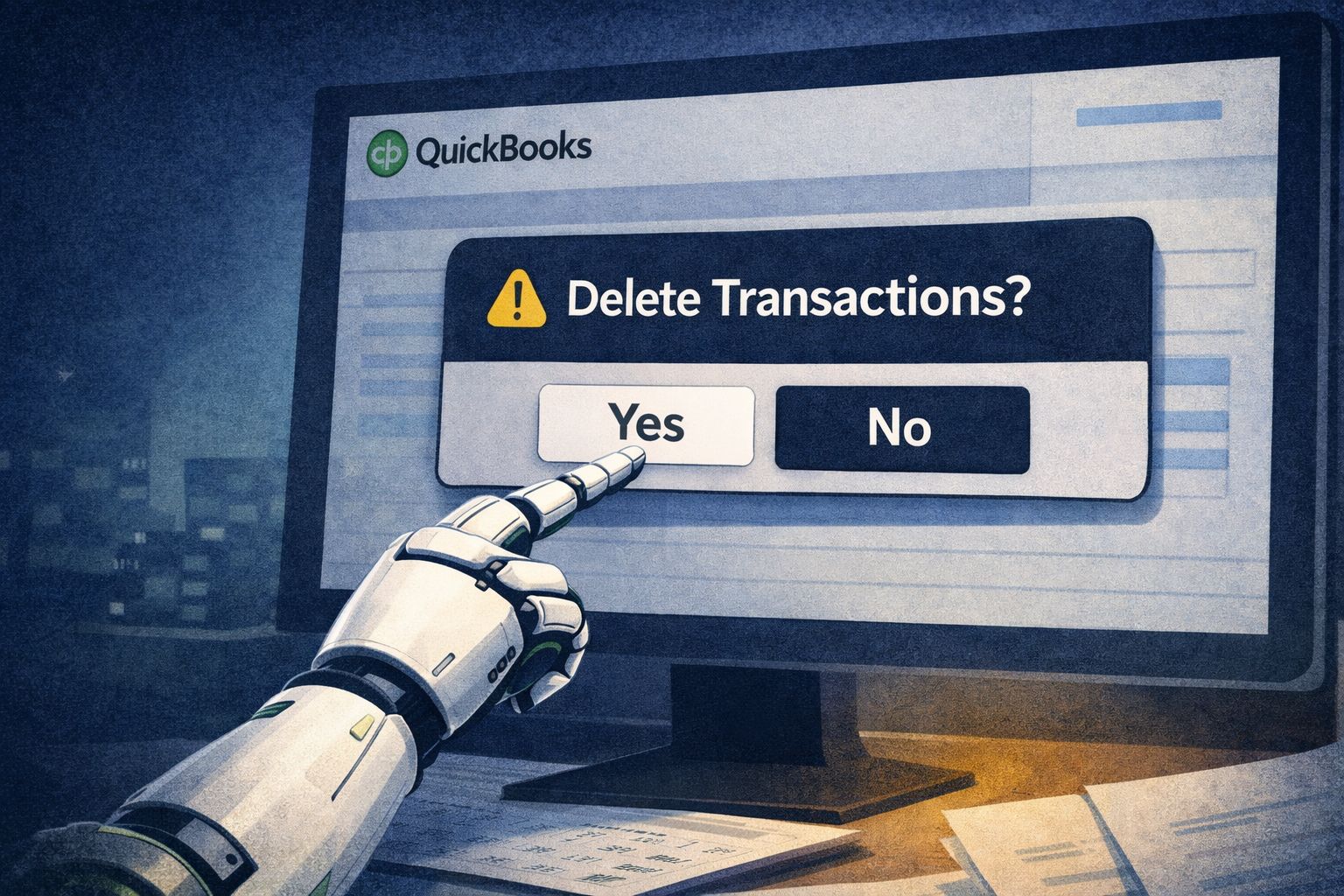
I immediately picked up the phone. Part of that was because I had recently shared the OpenClaw video from Jason Staats and could only imagine the level of access my buddy might have given this thing. I was also curious where the agent came from and who was training it.
I told him it did not need to delete and recreate anything. It needed to reclass. He knew deleting was not the answer; that is why he had the agent ask me. I think he eventually got it to do that. I hope. But the bigger point was not that one workflow. It was what that moment represents.
I think we are going to see more and more entrepreneurs show up to their accountant with an absolute train wreck of books because they unleashed an untrained agent on the file, got halfway there, and then gave up.
My Own Experiment With It
I used the same agent app to comb through the QuickBooks ProAdvisor directory, find LinkedIn profiles for ProAdvisors, and build me a lead list so I could spam them about FinDaily. Do not judge. Kids gotta eat.
What blew me away was how fast it did it. It put together almost 3,000 leads in a few hours. I have paid the monthly subscription cost for the app on Fiverr before, for maybe 300 leads, because it is such a manual, labor-intensive task. I did not have to provide the agent with any of my credentials. I just told it what I wanted, and it went and did it.
What This Means for CAS
That is the part I do not think accountants can ignore. These agents are no longer just theory. They are already useful. They are already fast. And they are already cheap enough that business owners will keep experimenting with them, whether we like it or not.
I am hearing examples of it constantly now. One client is looking at replacing part of their offshore medical billing with agents. Another is looking into having an agent take over part of the invoicing and collections cycle.
AI is getting better very quickly. I do not think that is up for debate. But the gap is still what happens in the real world. Business owners are not sitting around thinking about how to build elegant accounting workflows. They are thinking about sales, hiring, operations, customer issues, and cash. So when they plug an agent into the books, the result usually reflects that reality. Fast experimentation, incomplete setup, and a lot of missing context. That is still the monkey.
And I think that has a pretty important implication for CAS firms.
The lower-end tasks are going to keep getting taken over. Basic categorization. Data entry. Repeatable workflows. Pieces of invoicing and collections. That feels inevitable from here.
But I do not think that makes accountants less valuable. I think it makes the people side of accounting more valuable.
Someone still needs to understand the business behind the transaction. Someone still needs to know when a technically clean answer is the wrong answer. Someone still needs to connect the numbers to behavior, decisions, and next steps. That is the part clients actually pay for in advisory, and it is also the part these tools still struggle with. They can often tell you what changed. They still have a much harder time explaining why it happened and what should happen next.
So my takeaway is pretty simple. AI agents are coming for the lower-end work. In some cases, they are already here.
The more people-focused accountants can become now, the better. Because I think the firms that win won't be the ones pretending that’s happening. They are going to be the ones helping clients use it without wrecking the books.
Thanks for reading, Luke Templin!