- The CAS Cache
- Posts
- Accounting AI Keeps Building Pedestals, Not Training the Monkey
Accounting AI Keeps Building Pedestals, Not Training the Monkey

Luke Templin
March 11, 2026
✋Welcome to The CAS Cache, a newsletter designed to help accounting firms grow their CAS offerings in five minutes or less.
Disclaimer: Some links below support my writing of this newsletter, and some give you a deal.
Issue Sponsor 😎
Don’t outsource. Hire direct in the Philippines.
You can hire an accountant who works for you and only you. No middlemen. No ongoing fees. Just you and your team. Schedule a call with TeamUp now to learn how direct hire works.
Want to sponsor The CAS Cache? Reply to this email to get more details.
A friend who is a startup founder recently asked me which accounting technology will disrupt the small-business bookkeeping market. My answer surprised him.
I told him I do not see it happening anytime soon. Not because AI is weak. But because accounting technology companies keep building pedestals instead of training the monkey.
To explain what I meant, I shared a mental model from Astro Teller, the head of Google’s X Moonshot Factory. It turns out the framework describes the accounting tech landscape almost perfectly.
The Monkey and the Pedestal
Astro Teller teaches his teams a simple concept. Imagine your goal is to put on a show where a monkey stands on a pedestal and recites Shakespeare while juggling flaming torches.
There are two problems to solve. First, build the pedestal. Second, teach the monkey the act.
Most teams start with the pedestal. It feels like progress. You can design it, engineer it, and demo it. Investors understand it. Product teams can ship it.
But the pedestal is not the hard part. Teaching the monkey is.
Teller’s rule is simple. Tackle the monkey first. Because if the monkey cannot perform, the pedestal does not matter.
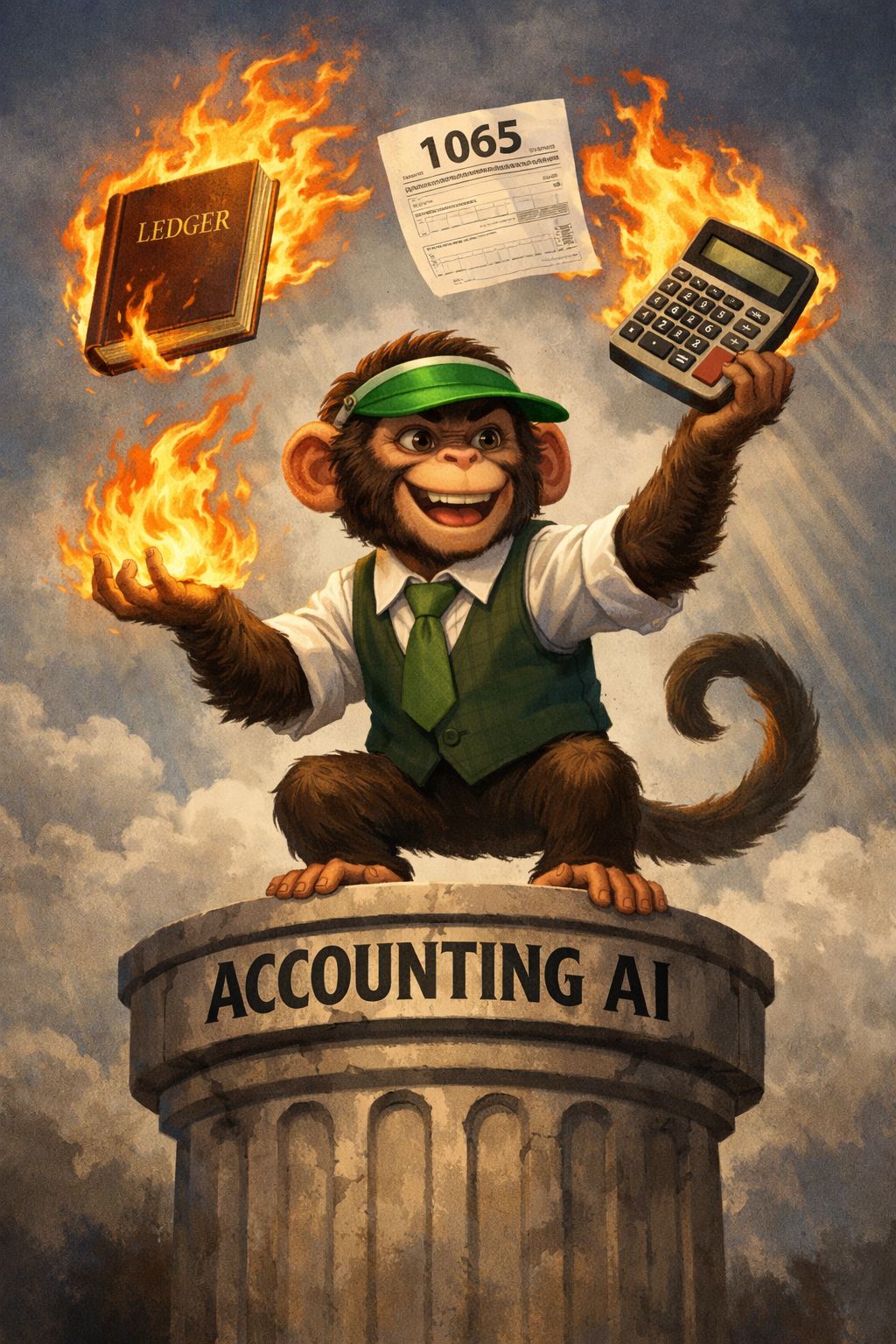
Accounting AI Loves Building Pedestals
Most AI accounting startups are building very impressive pedestals. They build automated categorization engines. Autonomous reconciliation tools. Month-end close automations.
And to be clear, these tools are helpful. Automation absolutely improves workflows inside accounting firms.
You can demo them. You can pitch them in a product roadmap. Pedestals are easy to show. The monkey, on the other hand, is messy.
The Real Monkey: Entrepreneurs
The hardest problem in small business accounting is not transaction categorization.
It is entrepreneurs.
Anyone who has worked closely with founders knows exactly what I mean. Entrepreneurs make decisions quickly, often based on instinct or urgency rather than process.
They move personal money into the business to make payroll during a cash crunch. They pay for employee tuition above IRS limits because they think it is the right thing to do. They launch a new idea before stopping to ask whether the company can afford it.
None of these decisions happen inside a clean accounting workflow. They happen in moments of pressure, optimism, or creativity. Then, someone has to figure out what actually happened financially.
That someone is usually the accountant. Until software can interpret that behavior, bookkeeping will always involve more than automation.
The Pedestal That Recently Fell
We saw a version of this challenge play out recently with Botkeeper.
The company raised close to $90 million and spent more than a decade building an AI-powered bookkeeping platform. The system could reconcile accounts and automatically categorize large portions of transactions. Yet despite the progress, the company ultimately shut down.
In explaining what happened, the founder pointed to a mix of factors, including pressure from venture funding and increased competition from other AI-native accounting startups. In other words, more pedestals.
The technology itself was not necessarily the problem. But technology alone was not enough to build a sustainable business in a market that still requires interpretation and judgment.
The Small Client Paradox
Another assumption baked into much accounting automation rarely gets challenged.
The assumption is that smaller companies should be easier to serve.
In practice, the opposite is often true. I touched on this in a previous issue about why some CAS clients pay more and ask less. Smaller companies often operate from a place of scarcity, while larger clients tend to operate from a place of abundance.
In my own CAS work, I have seen smaller clients consume far more time and attention than their size would suggest. Every expense feels significant. Every decision carries emotional weight. That mindset tends to create hesitation. Clients revisit small issues. They second-guess decisions. They compare options repeatedly because every dollar matters.
Contrast that with many larger clients I work with. They operate from a place of abundance. When we talk, the conversations are focused and high-level. They trust the process and move quickly.
Interestingly, the accounting work itself is not necessarily harder with the smaller client. But the environment around the work is much messier.
Processes are looser. Documentation is inconsistent. Financial decisions are made before anyone stops to model their impact. And that chaos is exactly what automation struggles to handle.
What This Means for CAS Firms
For firms building Client Accounting and Advisory Services, this reality should feel encouraging.
Automation will absolutely improve workflows. AI will automate many manual tasks that accountants have historically handled.
But the core challenge of translating messy entrepreneurial decisions into financial clarity is not going away.
If anything, it is becoming more valuable.
Because when technology builds pedestals, someone still needs to understand the monkey.
And that's exactly where great CAS firms operate.
Thanks for reading, Luke Templin!